When your furnace breaks down on a freezing winter evening in Westmoreland County, you need fast, trustworthy help from technicians who know residential heating inside and out. Greensburg Heating & Cooling provides round-the-clock emergency furnace repairs across Greensburg (15601), South Greensburg, Southwest Greensburg, and Hempfield Township. Our EPA-certified technicians arrive in fully equipped mobile units ready to diagnose and repair ignition failures, oxidized flame sensors, failing blower motors, and safety limit switch lockouts on the spot.
Residential furnaces rarely fail completely without displaying warning signs. Catching mechanical or electrical wear early prevents catastrophic mid-winter breakdowns and protects your family from hazardous safety issues.
If supply registers emit cool or cold air, the burners have failed to ignite or the system has entered safety lockout. Common causes include dirty flame sensors, broken hot surface igniters, or gas supply interruptions.
When a furnace turns on for 2 or 3 minutes and shuts down repeatedly, the internal heat exchanger is overheating. This is typically caused by choked air filters, blocked return registers, or failing high-limit switches.
Screeching or scraping points to worn blower motor bearings or a misaligned blower wheel. Loud booming sounds during ignition indicate delayed gas ignition, where unburned fuel builds up before igniting explosively.
Healthy natural gas burners produce a steady, crisp blue flame. A yellow, orange, or flickering flame indicates incomplete combustion, dirty burner orifices, or a dangerous lack of oxygen that produces carbon monoxide.
If the furnace blower fan never shuts off, even when heat is not actively called, the primary limit switch may be stuck open or the control board relay may have fused in the closed position.
A furnace that repeatedly trips its dedicated 15A or 20A circuit breaker suffers from an electrical short circuit, a seized motor drawing excessive starting amperage, or a failing 120V to 24V step-down transformer.
An unexplained jump in natural gas consumption without an accompanying change in outdoor weather signifies that dirty burners, improper manifold pressure, or degraded heat transfer are forcing the furnace to burn excess fuel.
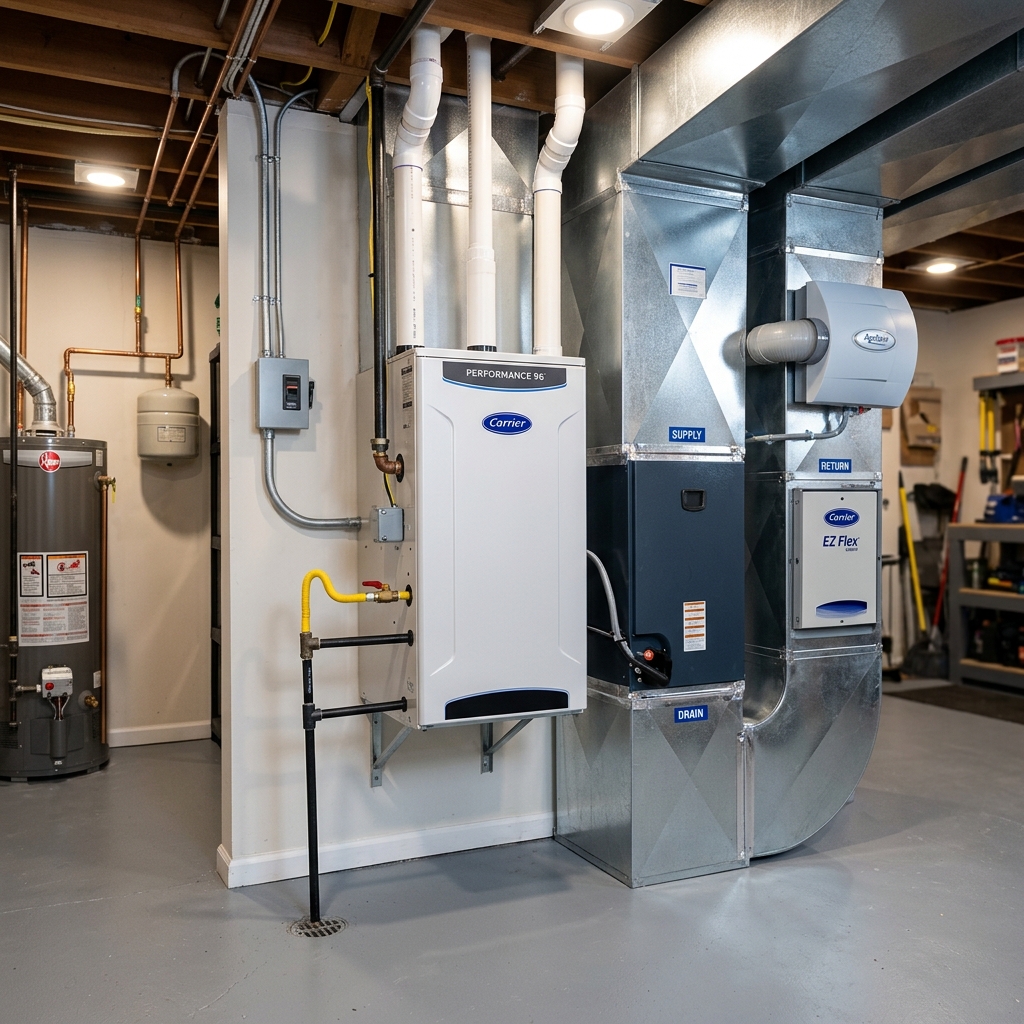
High-efficiency 90%+ condensing furnaces produce acidic condensation. When the internal condensate trap, PVC drain line, or drain pump clogs with algae or sediment, acidic water overflows, risking electrical board shorts.
Carbon monoxide (CO) is an odorless, tasteless, invisible poison produced by incomplete combustion in cracked furnace heat exchangers or blocked chimneys. Symptoms include sudden headaches, dizziness, nausea, confusion, and fatigue.
Action steps: Never assume a sounding CO alarm is false. Immediately evacuate everyone to fresh air, leave doors open behind you if possible, and dial 911 for fire department air quality sweeps. Do not re-enter your Greensburg residence until emergency services clear the building and our certified HVAC technicians inspect and tag the heating equipment.
Modern residential gas furnaces are complex systems combining high-voltage electricity, microamp electronics, mechanical air handling, and pressurized natural gas. Here is how our technicians diagnose and repair the core failure points.
The flame sensor utilizes the scientific principle of flame rectification, generating a tiny microamp direct current when engulfed in burner flame. Carbon and silica buildup insulates the metal rod, causing the control board to drop out the gas valve after 3 to 5 seconds. We use digital multimeters to measure DC microamps, polish the sensor with non-silica emery cloth, or install OEM factory replacements when the ceramic insulator has cracked.
Hot surface igniters operate similarly to incandescent light filaments, heating to over 2,000 degrees Fahrenheit to ignite natural gas. Because they experience violent thermal expansion cycles thousands of times every winter, the silicon element becomes brittle and fractures. Our technicians test resistance with an ohmmeter (standard reading between 40 and 100 Ohms) and install heavy-duty silicon nitride igniters designed for superior longevity.
The blower motor circulates conditioned air across the heat exchanger and throughout your home ductwork. When run capacitors lose microfarad rating, the motor overheats and trips internal thermal overload protectors. If bearings seize, the motor hums without spinning. We test capacitor tolerance with digital meters, lubricate ports if applicable, balance squirrel cage fan wheels, and replace worn PSC or ECM motors.
Limit switches are critical safety cutoffs that open electrical circuits if the plenum temperature exceeds safe factory thresholds. Repeated limit switch trips indicate airflow choke points like dirty filters or blocked registers. Flame rollout switches detect heat spilling backward out of the combustion chamber, a primary indicator of a cracked or soot-clogged heat exchanger that requires immediate professional evaluation.
The draft inducer fan creates a negative pressure vacuum through the heat exchanger, venting poisonous exhaust fumes out of the home. The differential pressure switch confirms this draft before enabling the gas valve. If the inducer motor fails, vacuum hoses crack, or exhaust vents are blocked by Laurel Highlands snowdrifts or bird nests, the furnace will not fire. We replace failing inducers and clear venting lines.
The electronic control board acts as the central brain of the furnace, sequencing relays, monitoring safety switches, and flashing diagnostic LED codes. Electrical power surges or water leaks can burn circuit board traces. Gas valves regulate incoming fuel pressure (typically 3.5 inches of water column for natural gas). We test voltage, replace fried control boards, and adjust gas manifold pressures.
Before paying for a professional diagnostic service call, verify these five simple items. Frequently, simple external factors like an accidental switch flip or dead thermostat batteries are the true cause of a heating outage.
Ensure the thermostat switch is set to HEAT, not COOL or OFF. Verify the setpoint temperature is at least 3 degrees higher than current room temperature, and replace AA or AAA batteries if screen is fading.
Look for the red-covered light switch on the wall near your basement stairs or directly mounted on the furnace cabinet. It can easily be bumped to the OFF position accidentally by children or holiday storage.
Check your electrical panel for the breaker labeled Furnace or Heating. If the switch sits in the middle tripped position, push firmly to OFF and then back to ON. If it trips again immediately, leave it off and call us.
Slide out your furnace air filter. If it is coated in a thick mat of dust, pet hair, and lint, airflow is restricted, causing the furnace to overheat and shut off. Replace with a clean filter immediately.
If you have a high-efficiency furnace with white PVC intake and exhaust pipes protruding from your home exterior foundation, ensure winter snowdrifts, ice dams, or leaves have not clogged the pipe openings.
Facing a major furnace repair estimate can be stressful. We provide objective guidance based on proven HVAC industry economics. Never spend good money patching an obsolete furnace that is on the verge of permanent structural failure.
Learn about our turn-key high-efficiency furnace replacements, rebates, and financing options in Greensburg, PA.
We believe in complete pricing transparency. Our technicians never begin repairs without presenting a clear, written estimate for your approval. You will never encounter unexpected mileage fees or surprise overtime surcharges.
Includes multi-point electrical diagnostics, flame sensor chemical cleaning, flame sensor replacement, standard run capacitor swaps, air filter replacement, and minor wiring corrections.
Includes hot surface igniter replacements, high-limit temperature switch swaps, differential draft pressure switch replacements, condensate trap clearing, and burner assembly cleaning.
Includes draft inducer blower motor replacements, circulating blower motor replacements, integrated digital control board replacements, and natural gas manifold valve installations.
Our service trucks are stocked with factory-authorized parts and universal diagnostic components for every leading residential heating brand installed across Westmoreland County.






Also servicing Carrier, York, American Standard, Ruud, Heil, Coleman, and Armstrong Air heating systems.
Based on 123+ local reviews
"Caleb performed a thorough check of my furnaces in Greensburg. I always trust the work this team and their technicians do. Arrived right on time and explained everything clearly."
"I was very satisfied and pleased with all the work done by Caleb and Brett. I needed a large variety of heating jobs done and each one was completed cleanly without any mess."
"They were able to get us in fast even though it was really hot outside and they were extremely busy. Great job! I would definitely use them again for our residential cooling needs."
Expert answers regarding emergency dispatch, pricing, troubleshooting, and safety.
Our local technicians are based directly in Greensburg, PA, allowing us to arrive at your doorstep swiftly for scheduled maintenance and 24/7 heating or cooling emergencies.
Greensburg
PA 15601
South Greensburg
PA 15601
Southwest Greensburg
PA 15601
Jeannette
PA 15644
Irwin
PA 15642
North Huntingdon
PA 15642
Murrysville
PA 15668
Delmont
PA 15626
Penn Township
PA 15644
Latrobe
PA 15650
Hempfield Township
PA 15601
Youngwood
PA 15697
Call our Greensburg dispatch office to verify immediate technician availability in your neighborhood.
Submit your repair inquiry below for prompt scheduling. For immediate 24/7 no-heat emergencies, please call (724) 482-3710 directly.
Centrally located on S Pennsylvania Ave, our mobile service trucks are dispatched directly across Greensburg, Hempfield Township, South Greensburg, and throughout Westmoreland County.
140 S Pennsylvania Ave, Greensburg, PA 15601, USA
Call: (724) 482-3710
24/7/365 Emergency Dispatch Ready
Our certified residential furnace technicians are ready 24/7 across Greensburg and Westmoreland County. Call (724) 482-3710 now for fast, flat-rate emergency heating restoration.